
Aging in Place Without Sacrificing Style
The best time to consider how your home will support you in the future is long before anything needs to change.
That does not mean designing around limitations you do not have. It means creating a home that remains comfortable, functional, and beautiful as life evolves. When done well, aging in place does not look clinical. It simply looks like good design.
For luxury homeowners, this is less about adding obvious safety features and more about making smart decisions during a renovation. Better lighting, generous pathways, accessible storage, and easier transitions between rooms can all be incorporated into a polished interior. The home feels elevated today while being better prepared for tomorrow.
Start With How You Want to Live
Aging in place is often treated like a standard checklist, but every homeowner’s plans are different.
Some homeowners want to remain in their primary residence for decades. Others are preparing a second home to become their full-time residence after retirement. There may also be visiting parents, adult children, or guests with different mobility needs to consider.
The design should reflect those realities.
A main-level primary suite may become more valuable than additional rooms upstairs. An open kitchen can support entertaining now while allowing for easier movement later. A guest bathroom with generous clearances can feel spacious and luxurious without drawing attention to its accessibility.
The goal is not to predict every possible change. It is to remove unnecessary obstacles and give the home room to adapt.
Create Ease Without Making It Obvious
Many of the most valuable aging-in-place features are already hallmarks of good design.
In the kitchen, deep drawers make cookware easier to reach than items stored at the back of a lower cabinet. Pull-out shelves reduce bending and searching. Appliances placed at comfortable heights make everyday tasks simpler without changing the character of the room.
The layout matters just as much as the cabinetry. Clear space around an island creates a better flow for entertaining and allows more freedom of movement. Thoughtful placement of the sink, cooktop, and refrigerator can also reduce unnecessary steps.
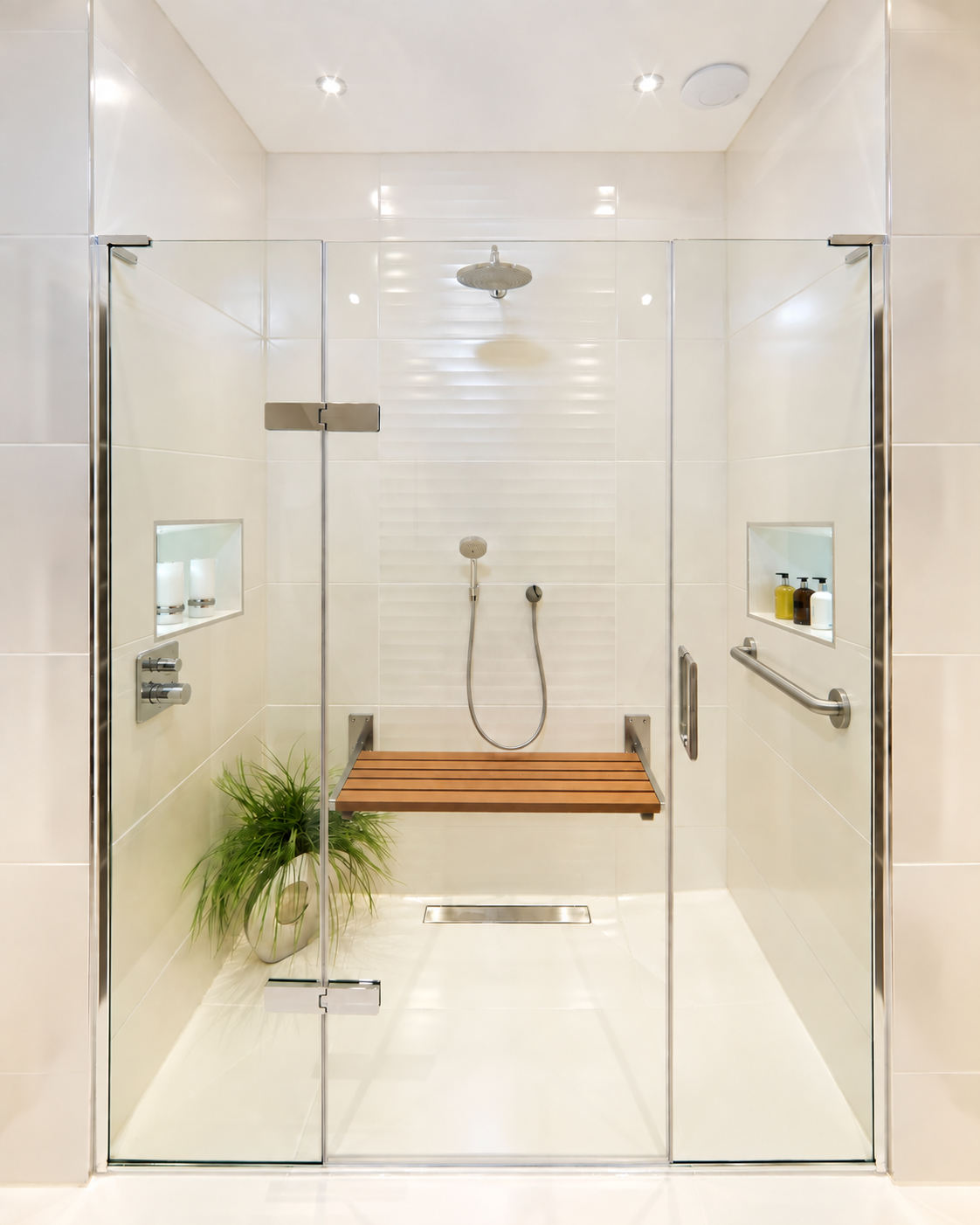
Bathrooms offer their own opportunities. A curbless shower creates a clean visual line while removing a common tripping point. A built-in bench can feel like a spa feature while adding comfort and flexibility. Handheld shower fixtures and well-placed niches can be selected as part of the overall design rather than added as an afterthought.
Future support can also be planned discreetly. Reinforcing the walls during construction makes it possible to install grab bars later without reopening the wall. For homeowners who need them now, beautifully designed options are available that feel intentional rather than institutional.
Give Lighting the Attention It Deserves
Lighting has a significant effect on how comfortable and usable a home feels. Over time, stronger and more evenly distributed light becomes increasingly important, especially in kitchens, bathrooms, hallways, and near changes in floor level.
One overhead fixture is rarely enough.
A layered lighting plan combines general illumination with focused light where tasks happen. Under-cabinet lighting improves visibility at kitchen counters. Lighting inside drawers and cabinets makes storage easier to navigate. Soft night lighting can guide movement through a bathroom or hallway without filling the space with harsh brightness.
Controls should be considered as carefully as the fixtures. Switches placed in intuitive locations, dimmers, and straightforward automation make lighting easier to manage. The technology should support daily life without making it more complicated.
Choose Materials for Beauty and Performance
Designing for longevity also means looking beyond how a material appears in a showroom.
Flooring should provide stability and allow for smooth transitions between rooms. High-gloss surfaces can create glare or become slippery in areas exposed to water. A durable matte finish may offer a better balance while still feeling refined.
Contrast can be used with restraint to make the home easier to navigate. A subtle change in color or material can help define the edge of a counter, step, or doorway without disrupting the design.
Hardware deserves the same consideration. Cabinet pulls should be comfortable to grip as well as beautiful to look at. Lever-style door handles are often easier to operate than knobs, and they are available in styles suited to both traditional and contemporary interiors.
These decisions do not detract from a room’s beauty. They contribute to how well the room works.
Plan for Longevity During the Renovation
A major renovation involves hundreds of decisions, making it easy to focus only on what the home needs today. Looking a little further ahead can prevent costly changes later.
This might mean improving doorway clearances while the walls are already open or creating an easier route from the garage into the home. In a bathroom, it could mean leaving enough space for future modifications. In a multilevel home, it may be worth identifying where an elevator or lift could be added someday, even when there is no immediate need for one.
Not every feature has to be installed now. Good planning preserves future options without changing how the home feels today.
A Home Designed to Last
Aging in place should not require sacrificing the materials, details, or sense of luxury that make a home feel personal. In fact, designing for longevity often results in a home that is more comfortable and better resolved from the beginning.
DIC Design Group helps homeowners consider both the present and the future through kitchen and bath renovations and full-service interior design. Every choice is made to support the way the home is lived in while preserving its warmth, elegance, and individuality.
Your home should continue to feel like your home, even as your needs change.
Schedule a consultation with DIC Design Group to begin planning a home designed to last.
Where desert luxury meets mountain elegance.