
A chandelier can light a dining room and still leave a favorite painting in shadow. A picture light can bring out the colors in that painting without changing how it feels to sit down at the table. Both fixtures belong in the room, but they have different jobs.
That distinction guided two recent projects: a traditional dining room and a modern upstairs landing. In the dining room, we wanted to give the table a stronger focal point and bring some light to the walls. On the landing, the decorative fixture was already doing its job. What needed attention was the wall beside it.
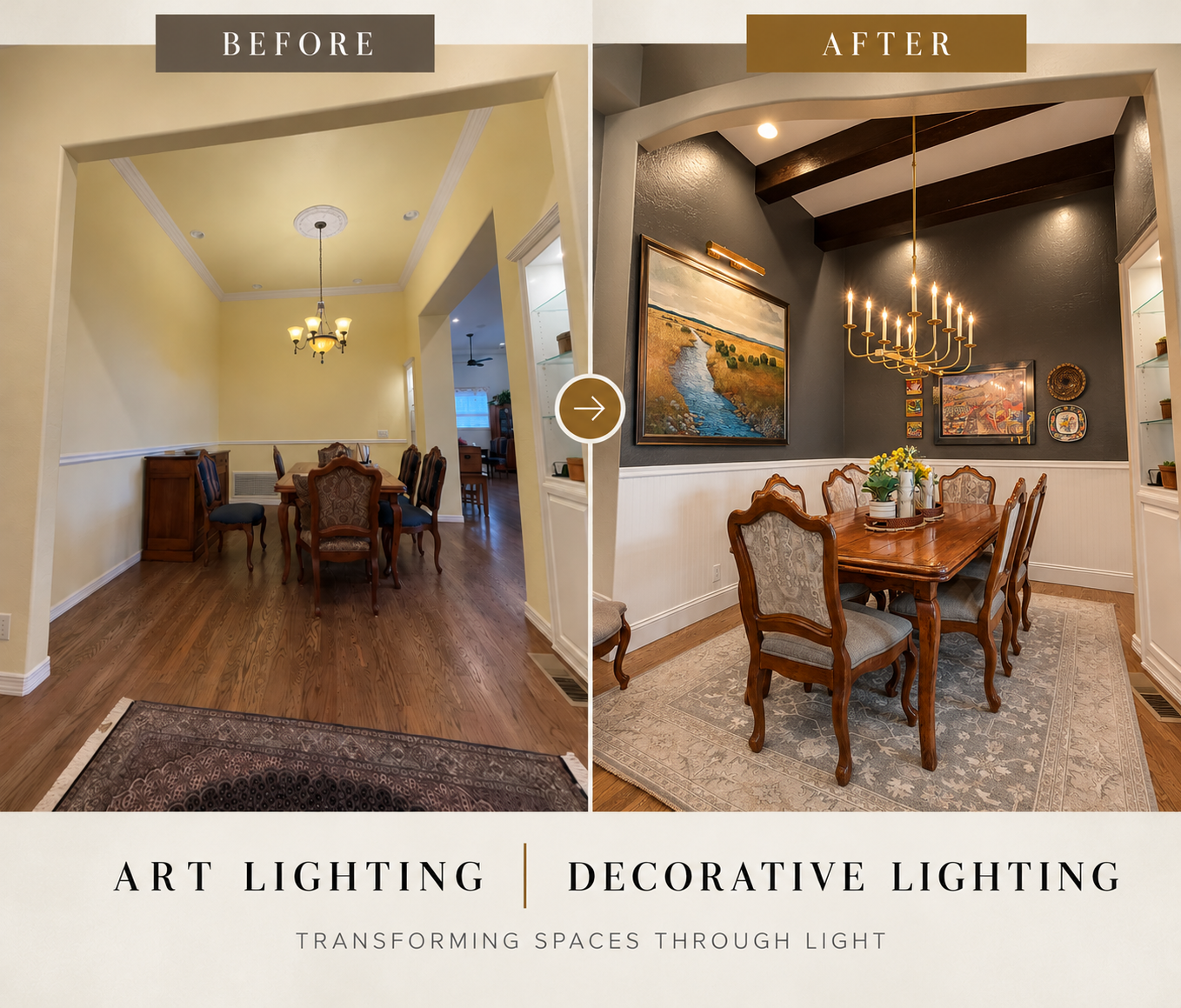
In the dining room, the chandelier and the artwork needed their own light
In the before photo, there’s already a chandelier over the table. It lights the center of the room, but there’s little to draw your eye toward the walls. In the after photo, you might see the new chandelier first, then follow the light over to the large landscape painting or across to the smaller pieces on the far wall. There’s more to take in from the doorway.
We replaced the chandelier with an open fixture with candle-style bulbs. Its shape gives it more presence above the table, and the exposed bulbs give the room a warm glow. We also added lights alongside the ceiling beams to carry light toward the walls. That placement matters in a room with dark walls and substantial beams: you can see the architecture around the table without asking the chandelier to light every corner.
The landscape painting has a picture light of its own. Look at how clearly you can see the blue of the water and the warm tones around it. That’s what we’re after when we light art: enough light in the right place to see what made you want to hang the piece in the first place.
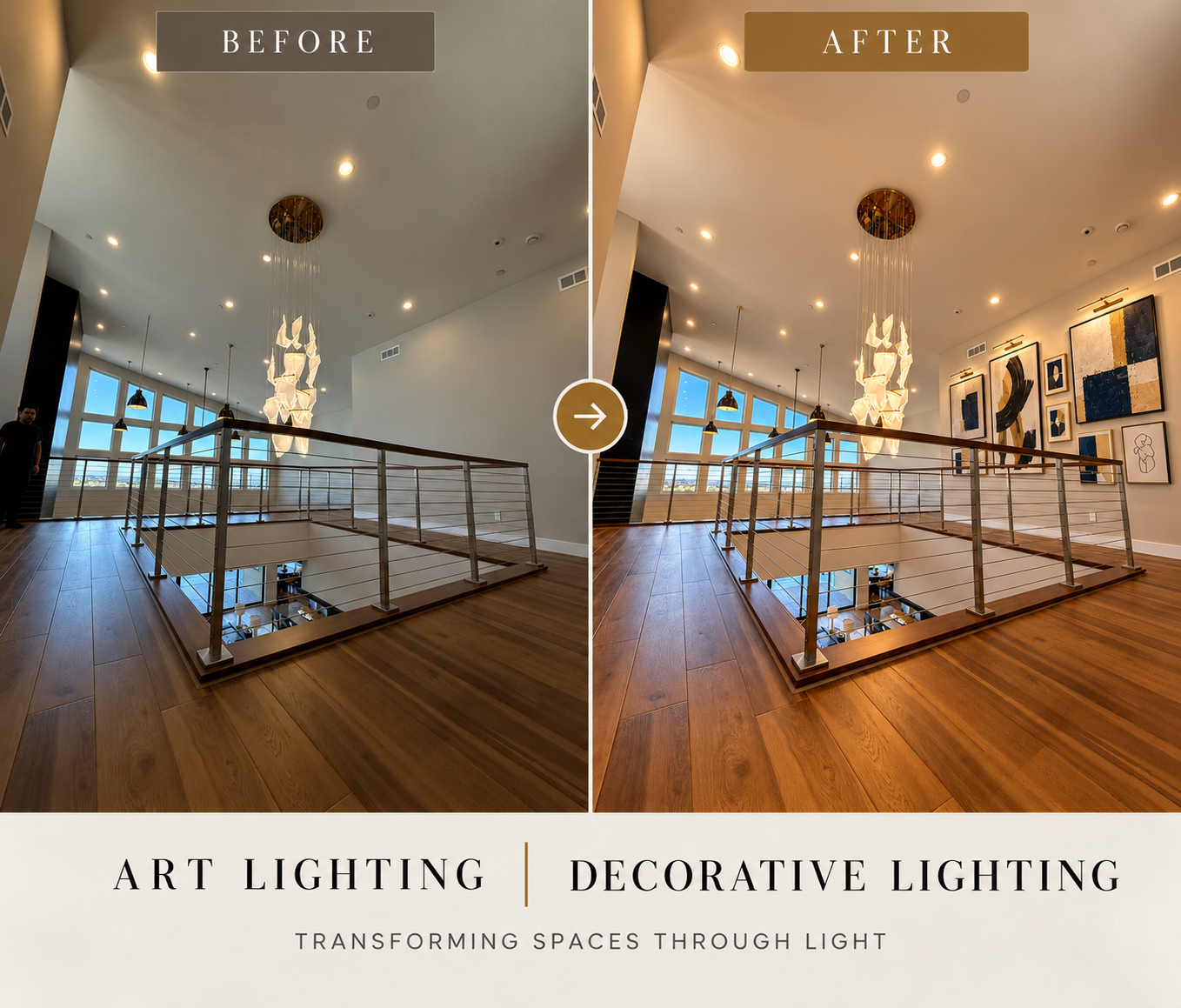
On the landing, we kept the pendant and brought the wall into view
The upstairs landing had a different starting point. The sculptural pendant was already a strong feature. It hangs through the stair opening, where you can see it from more than one level. It suited the space, so we kept it.
We arranged a collection of artwork on the long wall beside the railing and placed picture lights above several of the larger pieces. The fixtures draw your eye across the wall, and you can see the individual works from across the landing. Compare the two photos and notice how differently your eye moves through the space, even though the pendant stays put.
You can use the same approach with family photographs. Start by looking at the wall from where you usually pass it or sit across from it. Are faces easy to see after dark? Does an overhead light reflect off the glass? Those observations can help you decide whether to light one larger piece or spread a soft light across the whole arrangement. You don’t need a separate fixture over every frame.
Give each light a job
Decorative lighting contributes to the room as a whole. The fixture itself is part of the design, and its glow affects the space around it. Think of the chandelier over a dining table or the pendant over an open stair. Task lighting helps you see what you’re doing, whether you’re reading in a chair or chopping vegetables at the counter. Art lighting brings your eye to a painting, a photograph, or a collection so you can see the details.
If a room in your home feels unfinished, take a look at it in the evening with your usual lights on. Notice what your eye goes to first and what fades into the background. The fixture you already have may be doing its job. What’s missing might be a little light on something you’d love to see.
If you have a room that feels unfinished or artwork you’d love to bring into focus, I’d love to help. Get in touch with me at DIC Design Group and tell me a little about the room and what you’d like to change.